Your medics carry the whole medical system. Their records shouldn’t be on a scrap of paper.
Help is hours or days away
Weather, terrain and politics hold the evacuation. The medic manages trends, doses and consults for as long as it takes.
Paper and memory fail first
Cards get wet, lost or left behind. Re-dose times live in someone's head. The receiving hospital gets half the story.
Your patients' privacy is paramount
Your principal's, client's or teammate's health history can't end up in someone else's cloud. Unlike most apps, Uncharted sends no patient data home: no cloud sync, no analytics, no telemetry.
Who it's for
Built for medical programs that operate far from definitive care.
Executive protection & private security
From TCCC to paramedic-level care, a clear record supports better decisions. Discreet, defensible, and never stored on a server.
Family offices
Travel medics for families who expect discretion as much as clinical skill, aboard maritime vessels and on bespoke travel experiences.
Expedition & field research
Mountaineering, polar, overland and film teams where evacuation takes days. Serial vitals and re-dose timers in one record, a scripted sat-phone consult with your physician, and a GPS track and full Patient Care Report for the rescue team.
NGO & humanitarian teams
Prehospital charting for you or your grantees, entirely in the local language. Offline by default, with nothing to seize but an encrypted phone.
Tactical EMS
Ready for training or live operations, Uncharted helps SWAT and police medics manage patients from rural backroads to gridlocked city traffic, with a timestamped record for the after-action review.
Defense contractors & training cadre
Built for medics supporting deployed and austere operations, from point of injury through prolonged care: TCCC checklists, the prolonged casualty care tracker, and MIST and 9-Line reports, with no enterprise integration required.
Offshore & remote sites
Whether at a remote mining site or far offshore, Uncharted gives sole medics a complete record from the first call to the MEDEVAC, with protocols and your topside physician one tap away.
Remote EMS
For rural ambulance services and search and rescue teams with long transports and no coverage. Serial vitals, trends and timers for the whole call, and a Patient Care Report ready at the receiving facility, with no servers to run.
Why medical directors choose Uncharted
Six reasons it fits your program.
- 01
Works with nothing
Not "syncs when connected." Every feature, from voice MIST entry to PDF export, assumes there will never be a network.
- 02
Patient data stays on the device
No cloud sync, no telemetry on patient data, no user accounts. Records are encrypted with AES-256 on the phone that made them.
- 03
Reduces your medic's cognitive load
Your protocols built in for quick reference, report formats set up in advance, ideal body weight and fluid balance worked out for them, and timers so a dose is never missed.
- 04
Built for when help is hours away
Serial vitals with trends, re-dose and tourniquet timers that alarm on the lock screen, and a scripted telemedicine call to you.
- 05
On the device they already carry
Nobody goes anywhere without a phone now, so the record is always with your medic. Uncharted runs on iOS and Android phones and tablets, with a desktop app for review.
- 06
Built by operators
Founded and guided by a U.S. Special Operations veteran who knows what the job demands on the ground. Built by a principal software engineer to perform when it matters most.
How it works
One record, from point of injury to handoff.
- Point of injury
MIST by voice
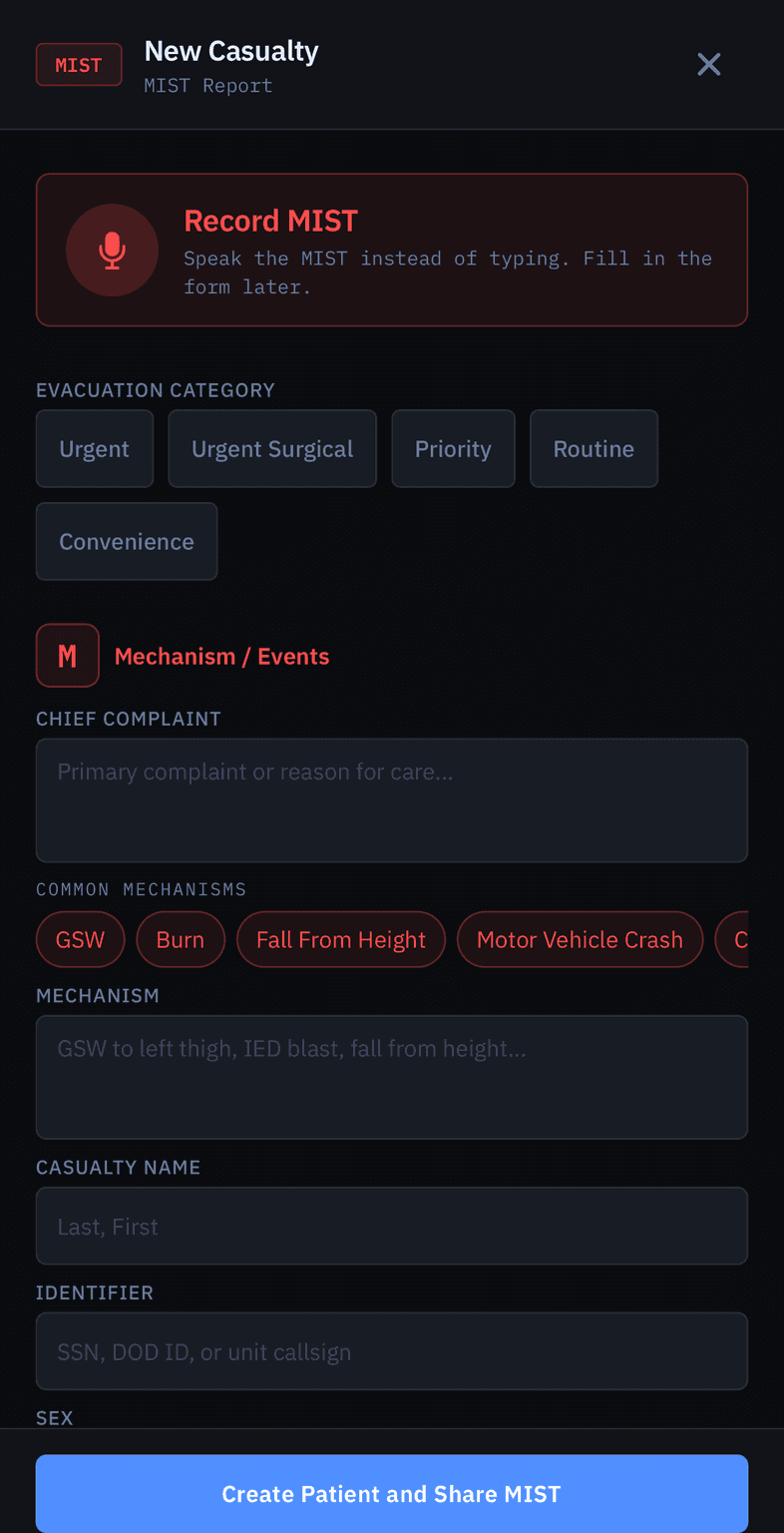
Speak it; it's transcribed on the device. Triage category set at intake.
- First hour
Treat and time
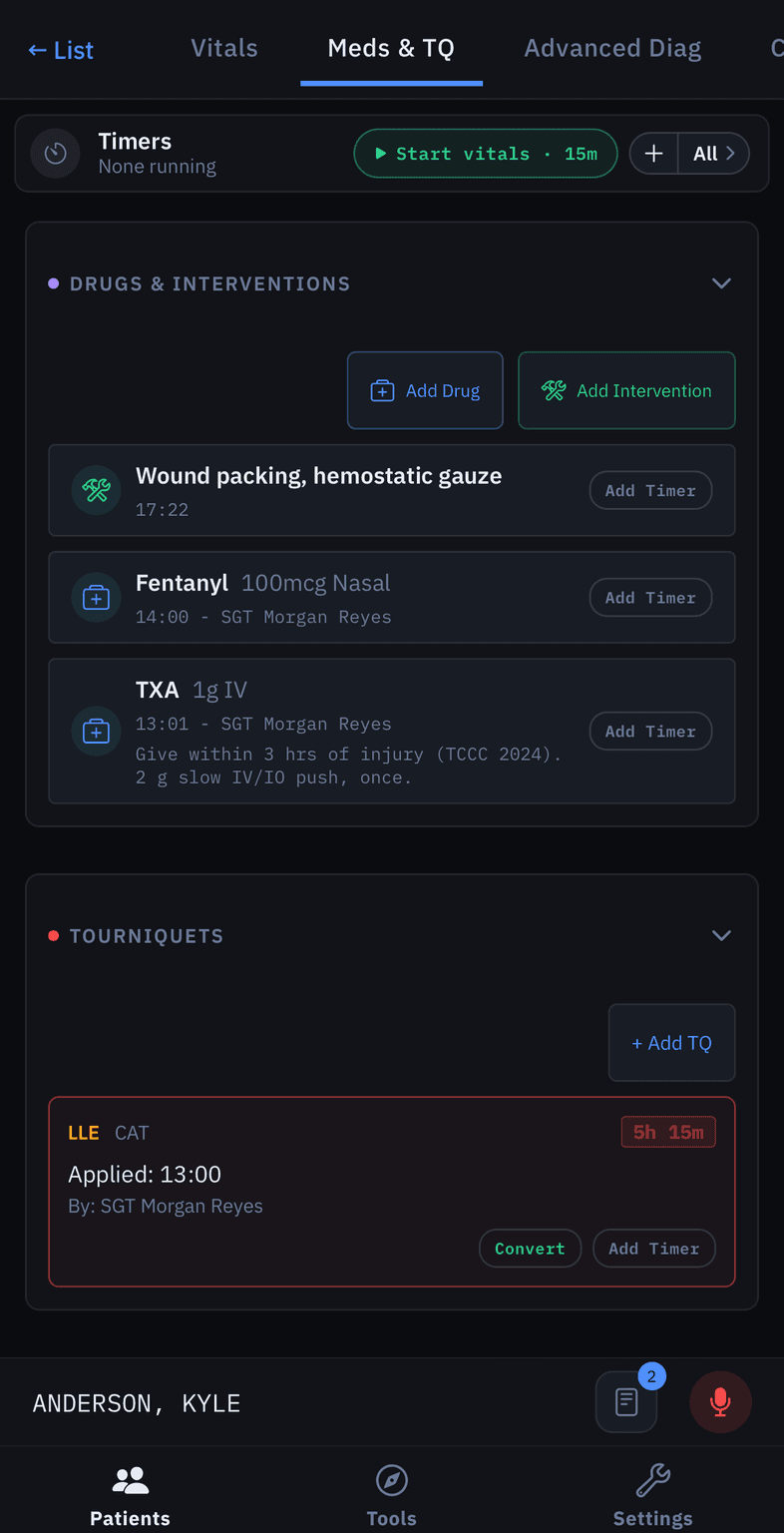
One-tap drugs and procedures, tourniquet clock, TCCC dosing hints.
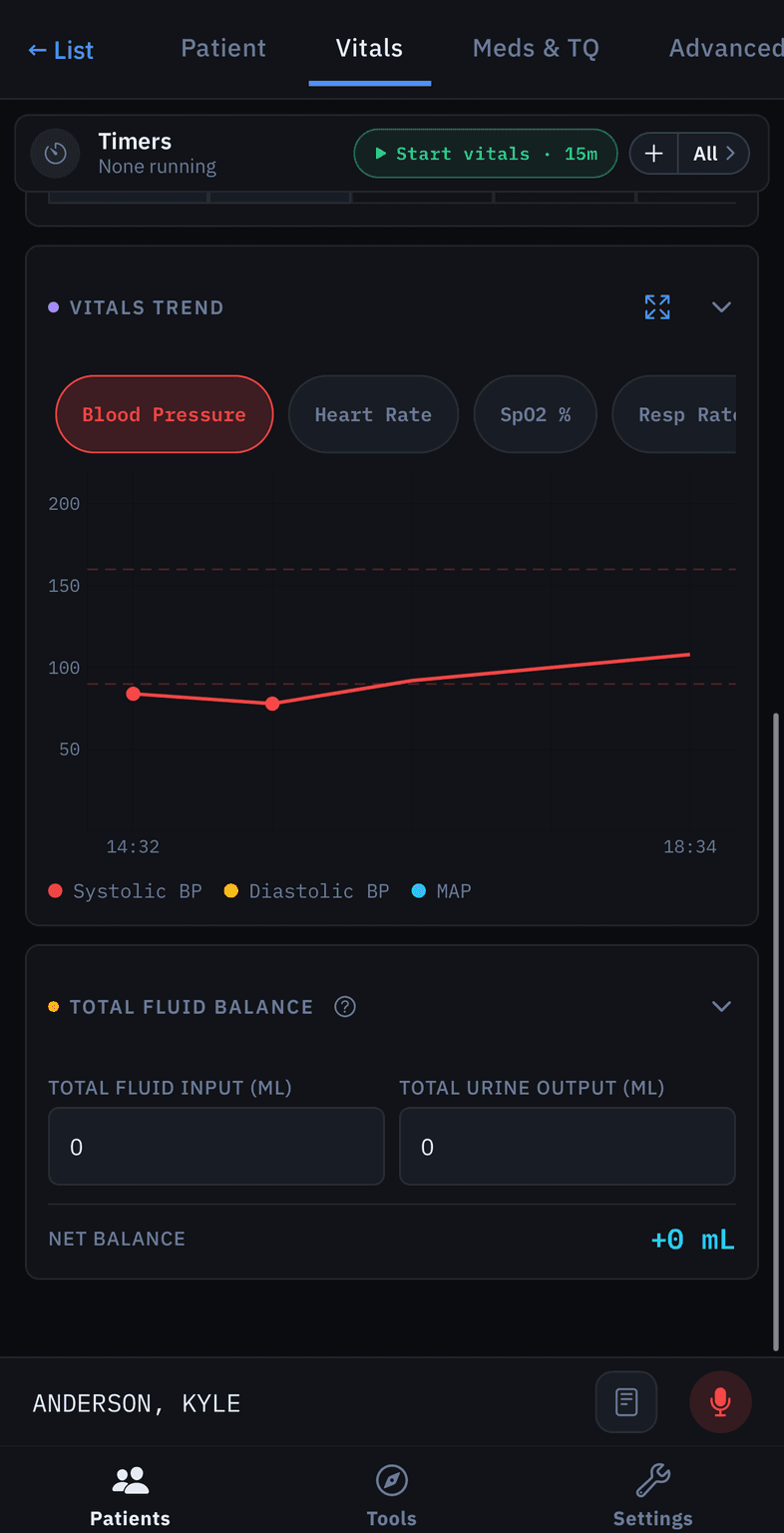
- Hours to days
Trend and re-dose
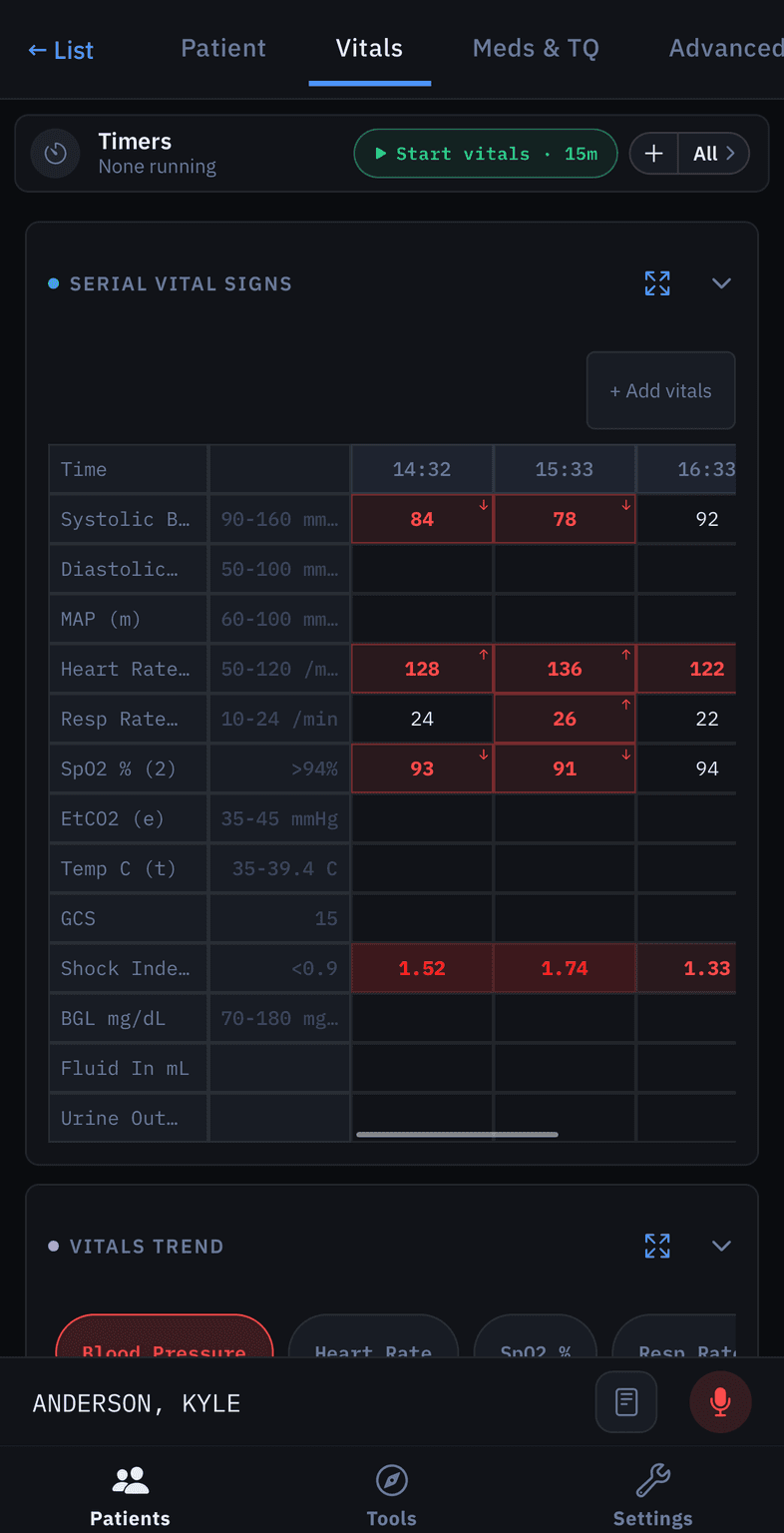
Out-of-range vitals flag red; MAP and shock index calculate themselves.
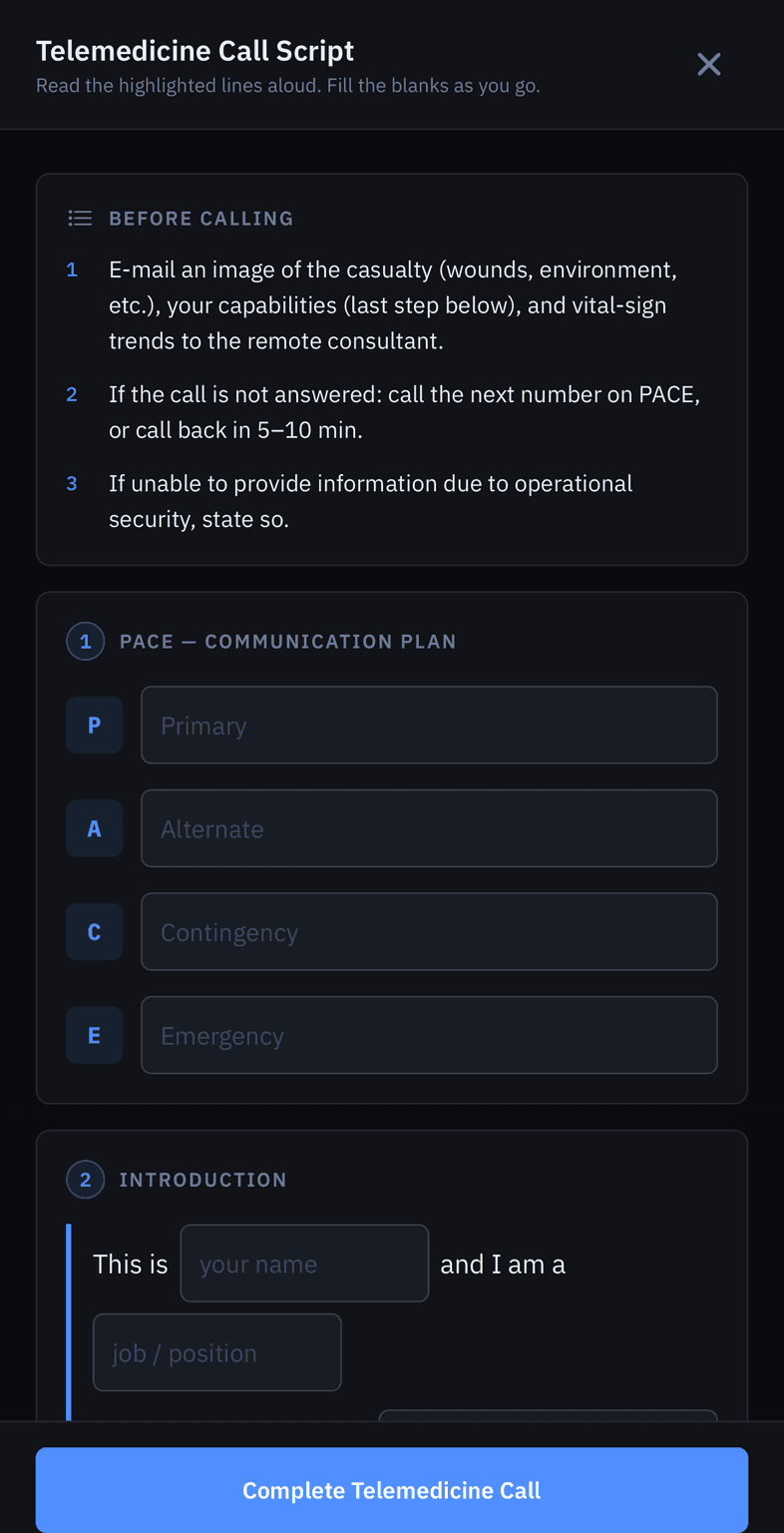
- Consult
Call the director
A guided script makes a sat-phone consult fast and complete.
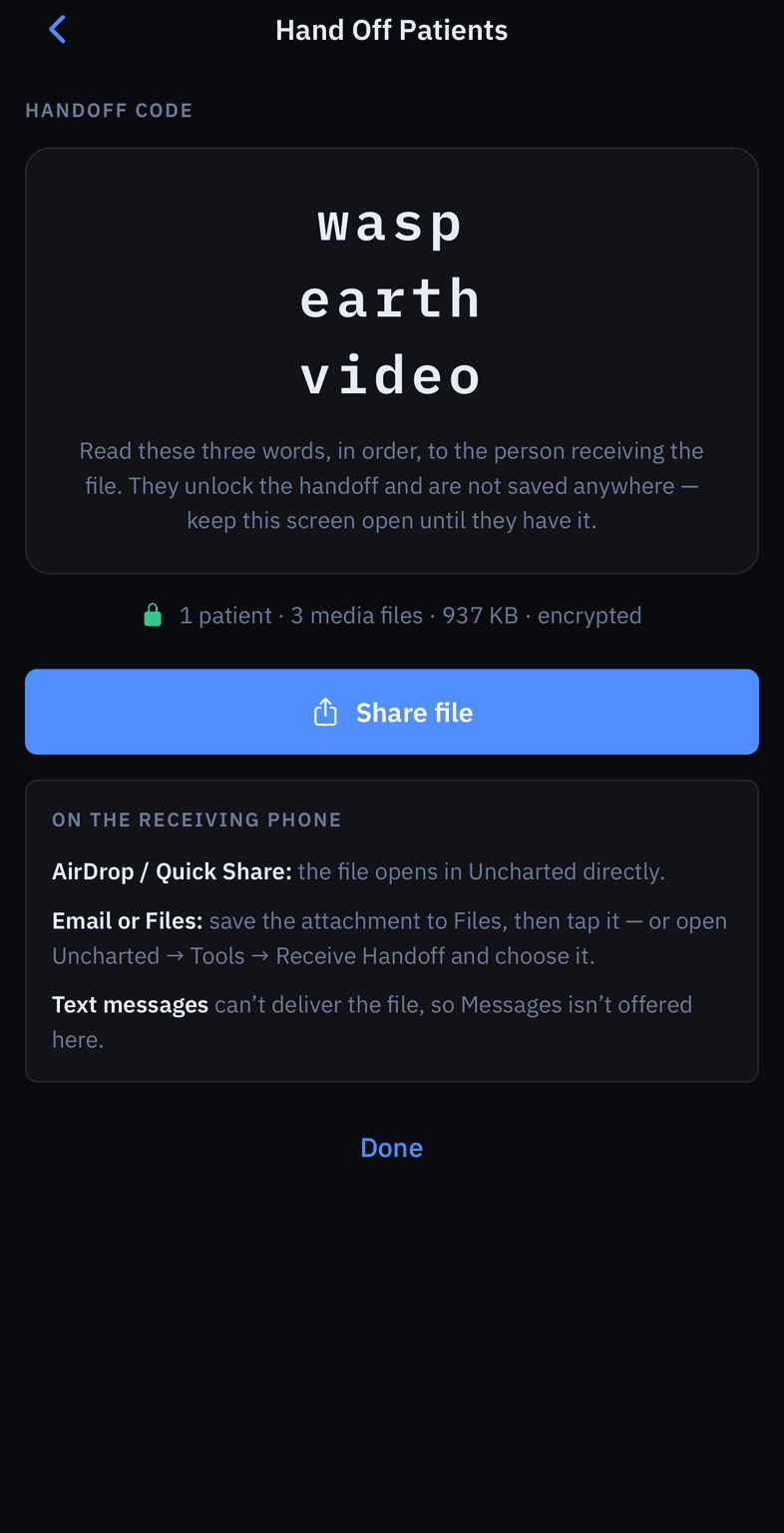
- Handoff
Sign and hand over
Patient Care Report, SOAP, MIST, 9-Line or your own template, as a PDF or device to device.
In the field
What it looks like when it counts.
The motorcade crash, 90 minutes from a trauma center
- MIST spoken in the back of the follow car, no signal
- Tourniquet clock and TXA logged; vitals flag a rising shock index
- Signed Patient Care Report handed to a foreign hospital; nothing stored in any cloud
Day three on the glacier, weather holding the helicopter
- 36 hours of serial vitals in one trend chart
- Scripted sat-phone consult with the expedition physician
- Re-dose timers through the night; SOAP note and photos at pickup
Officer down during a warrant service
- Tourniquet, chest seal and needle decompression in a few taps
- MIST report to the transporting crew, device to device
- A timestamped record for the after-action review
Crush injury on the platform, MEDEVAC four hours out
- Injury photographed and documented at the scene
- Topside physician one tap away; protocols readable offline
- Custom MEDEVAC request and a full Patient Care Report for the onshore clinic
A field clinic where a seized phone can't expose patients
- Records encrypted at rest; no server holding a patient list
- Program protocols imported as PDFs, readable with no signal
- Legible handoff to whichever facility can take the patient
A storm grounds every flight for a week
- Days of vitals, drugs and labs in one record
- Consistent telemedicine calls to specialists back home
- Full course of care reviewed on the desktop view
Security & privacy
The easiest security review you'll run this year.
There is no patient database to breach, because there is no patient database. Our admin portal only knows seats, codes and devices.
Read the security overviewPHI never leaves the device
No cloud sync and no telemetry on patient data.
AES-256 at rest
Every record, photo and audio note protected on the phone.
No user accounts
No passwords or rosters to manage, leak or sync.
HIPAA-ready
Encryption, biometric or PIN lock and a tamper-evident audit log, enforced on the device.
Licensing
Per seat, per year. Quoted for your program.
Purchase orders accepted and invoiced annually. Multi-year and volume terms available.
- 01
Agree seats and term. One seat covers a medic on up to three devices.
- 02
We set up your organization. Your admin is invited to the dashboard.
- 03
Assign activation codes. Reassign seats any time as contract medics rotate.
- 04
Medics activate and go. One-time step; everything after works offline.
Questions medical directors ask
If records stay on the device, how do I review my medics' care?
Medics export signed PDFs (Patient Care Report, SOAP, MIST, 9-Line or your template) and an activity log, and send them to you through your own channels when they can. A complete record can also be handed off, encrypted, to another Uncharted device for review.
Can we use our own protocols?
Yes. Paste text or import PDFs; they're readable with no signal. Add your number, the receiving hospital and dispatch as one-tap contacts.
Most of our encounters are illness, not trauma. Does it fit?
Yes. Alongside the trauma tools, the record covers history, neuro exams including the NIHSS, labs and EKG, and generates a SOAP note. Turn off the sections your program never uses in Settings.
What happens if a phone is lost or a medic leaves?
Deactivate the device from the admin dashboard and reassign the seat. Records on the device stay encrypted at rest.