
For EMS agencies, rescue teams and medical programs
Pre-hospital documentation your organization can stand behind.
Uncharted gives your medics an offline, encrypted patient record that starts at first contact and travels to the receiving facility. Fewer undocumented patients, complete handoffs, and a tamper-evident chart when someone asks what happened.
- Fully offline
- AES-256 at rest
- HIPAA-ready
- iOS & Android
- Per-seat licensing

The field record is the weakest link in the chain of care.
Care that is not documented cannot be reviewed, defended, or improved. The evidence from civilian EMS and trauma systems, and from the military units that measured it, points the same way.
- 1 in 4
- key prehospital findings spoken at a trauma-center handover never reach the hospital chart. Prehospital hypotension was recorded in 10 of the 28 handovers where the medic reported it.3
- 5 of 18
- key fields in one state’s EMS records were reliably filled in. The other 13 were missing or invalid more than a tenth of the time, with no improvement over six years.4
- $3M
- paid by one medical center to settle HIPAA violations after a lost unencrypted flash drive and a stolen unencrypted laptop. Encrypted data is the safe harbor.6
What changes when your team charts in Uncharted.
- Documentation rate
Every patient gets a record, not just the ones with time to spare.
On a long carry-out or a two-hour transport, the chart is the last thing a medic has hands for, and it shows: in the one system that measured it, point-of-injury documentation existed for 14.7% of patients, while the units that documented nearly every one also had the lowest rate of preventable death.12 Uncharted opens straight into a structured intake, takes a spoken report and transcribes it on the device, and needs no signal at any step. The first entry takes seconds, so the record starts at first contact instead of being reconstructed from memory at handoff.
- Structured intake with one-tap mechanism and treatment chips
- Voice entry transcribed on device, no network
- Works for the whole call with no coverage
- Prolonged care & handoff
Keep medics ahead of the patient over hours, then hand off the whole record.
Pre-hospital care that lasts hours or days is where trends, re-dose times and tourniquet clocks get lost. Uncharted flags out-of-range vitals as they are saved, derives every timer from the recorded application time, and generates a PCR, SOAP note or MIST report from what was documented. Even a direct verbal handover loses about a quarter of what the medic says,3 so the receiving medic can instead take the full record onto their own device and keep charting in it.
- Serial vitals with MAP, shock index and trend charts
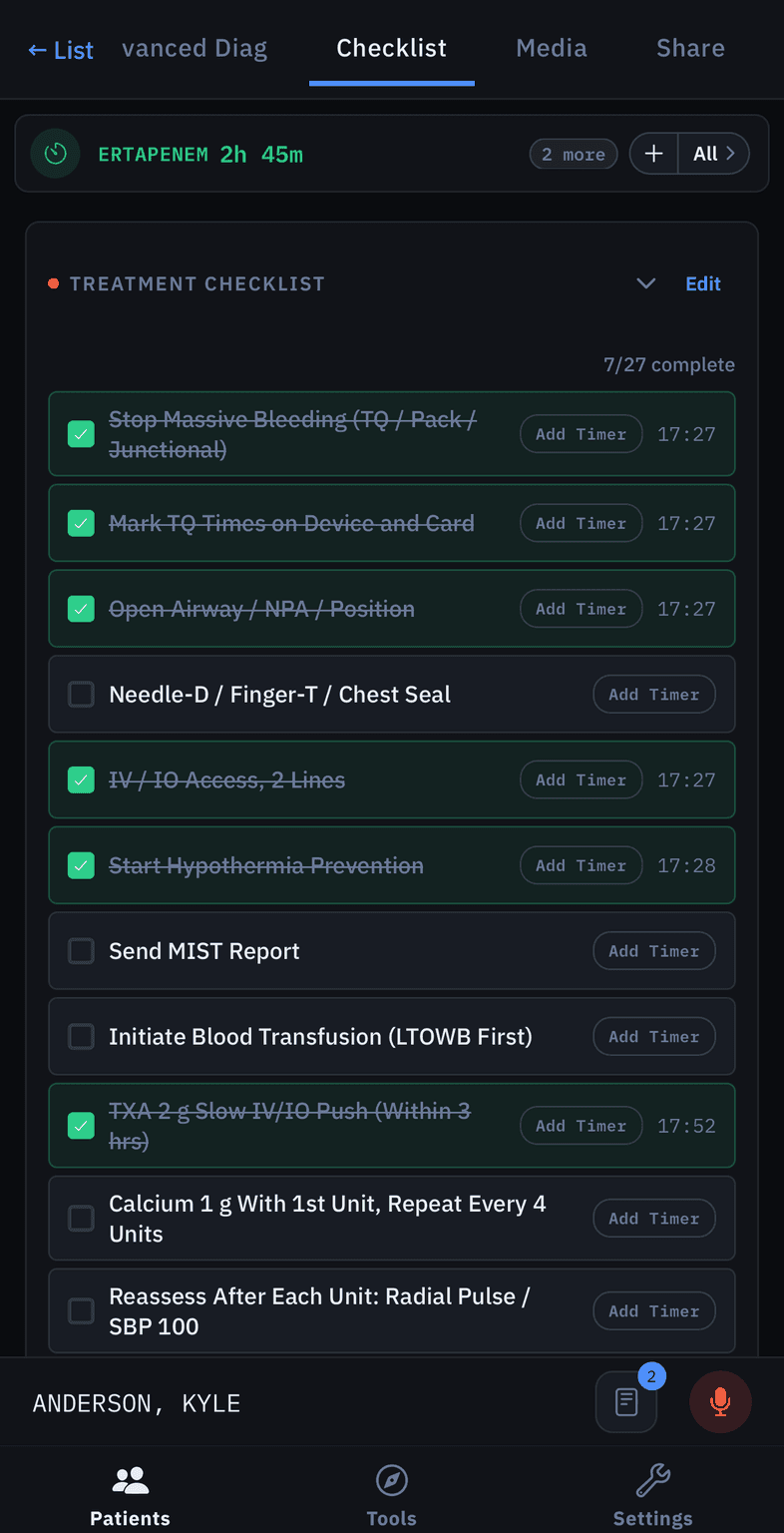
- Tourniquet, TXA, reassessment and re-dose timers that alarm on the lock screen
- Encrypted device-to-device handoff of the complete record
- Liability
A record that holds up when someone asks what happened.
Courts have treated negligent record-keeping as separate from the care itself, outside the immunity that covers treatment decisions.5 Uncharted writes every create, edit, export and delete to a hash-chained audit log, stamps forensic times in UTC, and signs exported reports with a hash of the PDF. The record shows what was done, when, and by whom, and shows that nothing was altered after the fact.
- Tamper-evident audit log inside the encrypted database
- Signed PDF exports with an audit entry and document hash
- UTC timestamps, displayed in local time
- Standardization
One way of charting across the team, with your protocols in the app.
Load your own protocols as text or PDF and they are readable with no signal, next to the contacts your medics call most. Configure which sections and fields they see so the record matches your scope of practice, without ever hiding data that has been recorded. Treatment checklists are built on current prehospital trauma guidance (TCCC 2024 and the Joint Trauma System guidelines) for teams that want them.
- Your protocols, medical director and receiving facilities on every device
- Sections and fields configured to your scope of practice
- Treatment and prolonged-care checklists grounded in current guidance
- Review & training
Case review from the actual record, not a recollection.
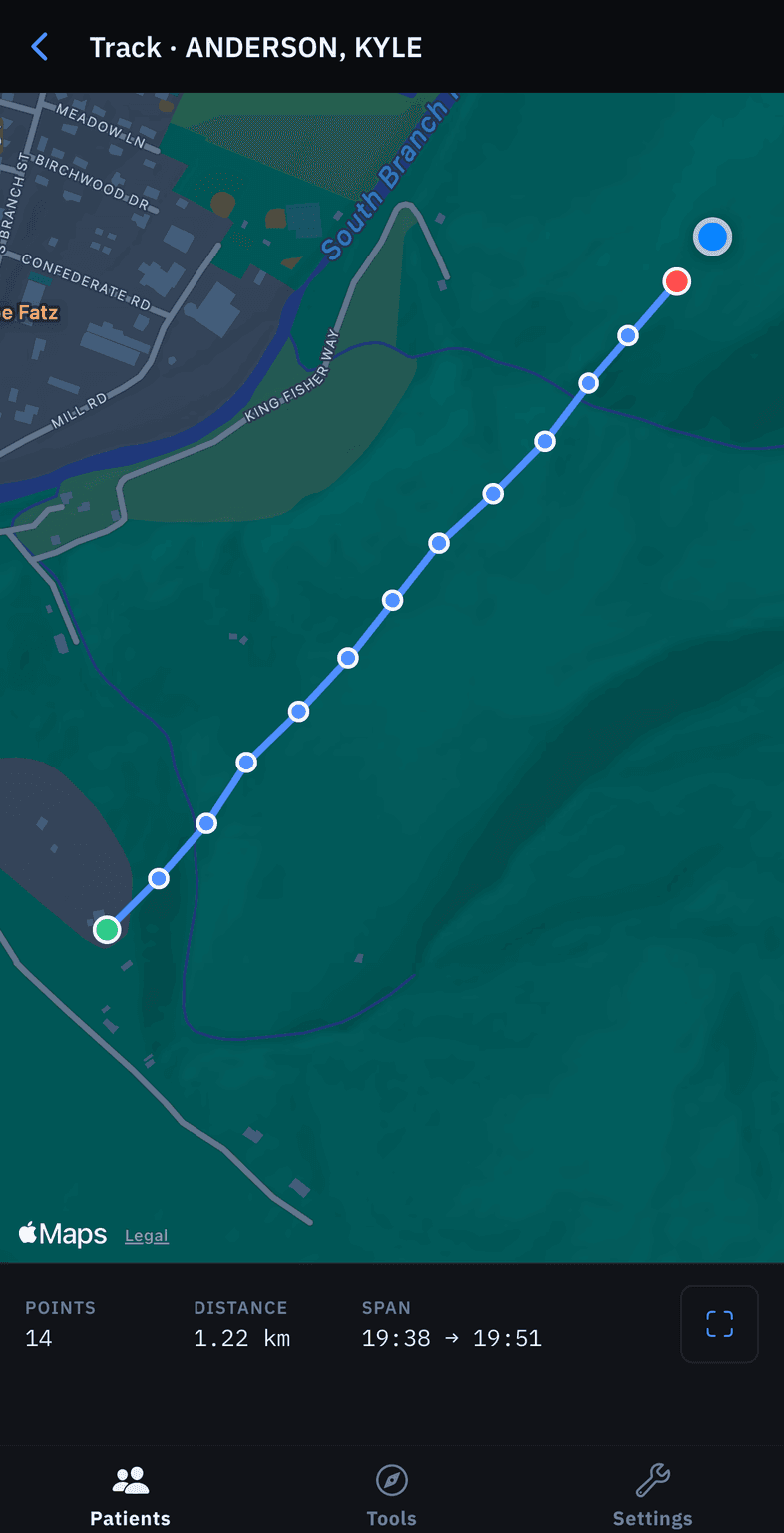
Quality improvement and medical-director review need the time series, not a narrative written later, and incomplete records are the norm in state EMS data.4 Each patient exports as a PCR with embedded photos, an activity log, a GPS track and the vitals history, so case review and training work from what was recorded in the field.
- PCR, SOAP and MIST exports per patient, or your own format
- Activity log and GPS track exports for review
- Clinical and environmental photos with captions
- Security
No server holding your records, so there is nothing of yours to breach.
A lost unencrypted device has cost a healthcare organization $3 million in settlements.6 Uncharted keeps patient data on the device only, inside an AES-256 encrypted database with hardware-backed keys, behind biometric or PIN lock. There is no cloud sync and no telemetry on patient data. A lost phone is an encrypted store, which is where the HIPAA safe harbor begins.
- SQLCipher AES-256 database, keys in Keychain or Keystore
- Photos sandboxed and EXIF-stripped, never the camera roll
- Biometric or PIN lock gates every patient screen
Built for teams that work far from a hospital.
Rural & remote EMS, search and rescue
Agencies and teams with long transports and no coverage: backcountry and mountain rescue, ski patrol, rural ambulance services. Serial vitals, trends and timers over hours, then a PCR for the receiving facility.
Expedition, industrial & event medicine
Offshore, mining, wildland fire, expedition and NGO medical programs working far from a hospital. Protocols on device, a telemedicine call script, and a record for the evacuation chain.
Military & tactical medicine
Point of injury through prolonged casualty care. MIST and 9-Line reports, TCCC checklists and the PCC nursing care tracker, with no reliance on comms.


Built for how your organization buys.
The questions a program lead, medical director or procurement officer asks first, answered plainly. The security page has the architecture in the detail a compliance review needs.
- How is it licensed?
- By seat. Each seat activates on up to three devices, so a phone, a backup and a tablet share one license. Seats are reassigned from the admin dashboard as personnel rotate.
- How do medics get set up?
- Your admin receives activation codes in the dashboard and assigns them to medics. Medics install the app from the App Store or Google Play and enter a code. There are no accounts to provision and no rosters to sync.
- Issued devices or BYOD?
- Either. The app runs on iOS and Android and is self-contained on the device, so it fits an MDM-managed fleet or personal phones under your device policy.
- Who holds the patient data?
- You do. Patient records never leave the device; Uncharted operates no server that stores them. Our portal handles seats, codes and devices only, so there is no vendor PHI store to assess.
- What does the record export as?
- Standard PDF reports (PCR, SOAP, MIST or your own format), an activity log export, and an encrypted handoff file that another Uncharted device can import in full.
- Can we procure with a PO?
- Yes. Invoice and PO-based procurement are supported for agencies, teams and programs. Tell us your process and we will fit it.
Sources
- 1.Kotwal RS et al. Saving Lives on the Battlefield: a Joint Trauma System review of pre-hospital trauma care in CJOA-Afghanistan. US Central Command, January 2013. Point-of-injury documentation was present for 14.7% of casualties in the DoD Trauma Registry for FY2012; the 75th Ranger Regiment documented nearly 100%. Source
- 2.Kotwal RS et al. Eliminating preventable death on the battlefield. Archives of Surgery 2011;146(12):1350. The Ranger casualty-response system, which included near-universal casualty documentation, recorded no potentially survivable pre-hospital deaths over ten years, against roughly one in four pre-hospital deaths judged potentially preventable force-wide (Eastridge BJ et al., J Trauma 2012). Documentation is one component of that system, not the sole cause. Source
- 3.Carter AJ, Davis KA, Evans LV, Cone DC. Information loss in emergency medical services handover of trauma patients. Prehospital Emergency Care 2009;13(3):280. Across 96 video-recorded trauma handovers at a Level I center, only 72.9% of the key prehospital data points paramedics stated aloud were documented by the receiving team; prehospital hypotension was recorded in 10 of the 28 handovers in which it was reported. Source
- 4.Abir M et al. Data missingness in the Michigan NEMSIS (MI-EMSIS) dataset: a mixed-methods study. International Journal of Emergency Medicine 2021;14:24. Across Michigan electronic patient care records from 2010 to 2015, only 5 of 18 key variables had less than 10% missing or invalid values, with no improvement over time; causes included unclear definitions and a lack of training and infrastructure for data collection. Source
- 5.DeTarquino v. City of Jersey City, 352 N.J. Super. 450 (App. Div. 2002). A New Jersey appellate court held that statutory immunity for EMS treatment did not extend to negligent record-keeping, after a run sheet omitted a symptom that the emergency department relied on. Source
- 6.HHS Office for Civil Rights, November 2019. University of Rochester Medical Center paid $3 million to settle potential HIPAA violations after a lost unencrypted flash drive and a stolen unencrypted laptop. Encrypted data is a safe harbor under the HIPAA Breach Notification Rule. Source